Why BYD started its own fleet of car-carrying ships
China’s car exports outgrew the world’s fleet of car carriers, and hiring one cost a fortune, so BYD started running its own. Now it knows what each crossing will cost and when its cars will sail, and every ship carries its name.
In 2023 there weren’t enough car carriers, the ships that take cars across oceans, to move all of China’s car exports. That year China passed Japan to become the world’s biggest car exporter, shipping about 4.9 million vehicles, according to the China Association of Automobile Manufacturers. As exports climbed, the price of hiring a car carrier went through the roof: charter rates hit record highs in 2022 and 2023.
These ships are floating multi-storey car parks, with a dozen or so decks and a ramp at the back, and drivers roll each car on board, park it nose to tail and lash it down for the crossing. Most modern ones hold between about 4,000 and 8,000 cars, though the largest now built carry more than 9,000. For years there had been just enough of them to go round. A decade ago China’s carmakers sold almost entirely at home. In 2024, by the association’s count, the country shipped close to 6 million vehicles abroad. The world’s fleet of car carriers couldn’t grow that fast. Few new ships had been ordered for years, and a car carrier takes two years or more to build. Chinese carmakers that went looking for shipping space often found it already booked by older carmakers on long contracts.
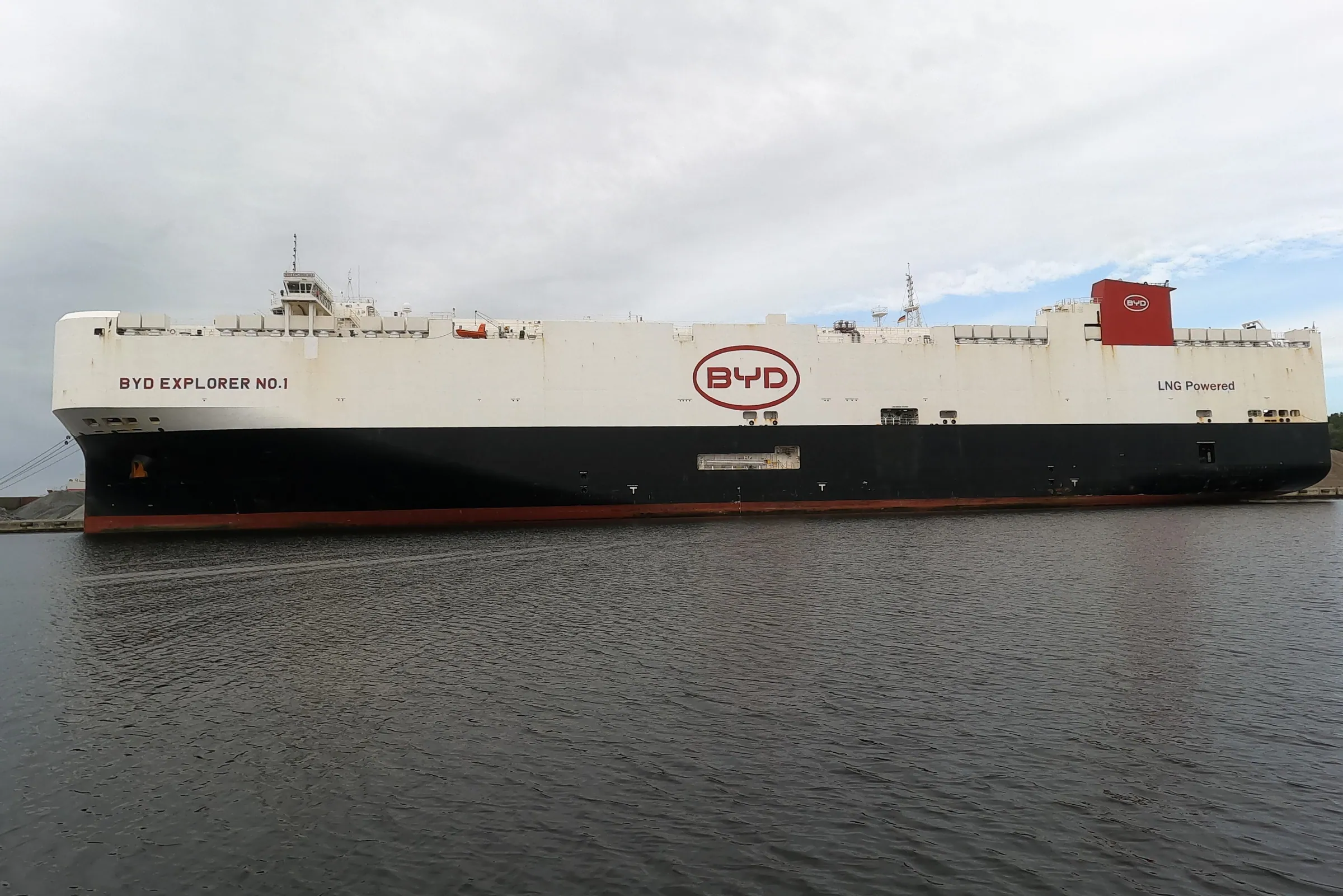
To deal with the shortage, BYD stopped renting space on other people’s ships and started running its own. The first, BYD Explorer No.1, was named in January 2024. About 200 metres long, it carries around 7,000 cars and runs on liquefied natural gas as well as conventional fuel, which cuts its emissions. “LNG Powered” is painted near the stern, next to the BYD logo. The ship is white, with a red funnel and BYD’s name along its side in letters taller than a person. In February 2024 it tied up in Vlissingen, in the Netherlands, after sailing from Shenzhen with more than 5,000 BYD cars on board.
More ships followed through 2024 and 2025. They are named after Chinese cities where BYD has factories: BYD Changzhou, BYD Hefei, BYD Xi’an and others. The biggest so far, BYD Shenzhen, can carry about 9,200 cars, and when it was delivered in 2025 it was the largest car carrier in the world. BYD owns some of the ships in its fleet and hires others on long contracts. Either way they carry its name and its cars.
What owning the ships buys BYD
Shipping is paid on every car. A carmaker that rents space pays whatever the market asks when rates spike, and when space is short it waits its turn. BYD knows what each crossing will cost and decides where its ships go and when, so it can plan a car launch in Brazil or Australia around a sailing date. And a 200-metre hull with a giant BYD logo, sailing into Bremerhaven or Vlissingen, is a billboard no media buyer could arrange.
BYD and the other big Chinese carmakers now run their own battery plants and chip teams, the way global manufacturers do. SAIC, China’s biggest car group, also runs its own car carriers, through its logistics company, Anji. Other Chinese carmakers have hired or ordered ships of their own.
EU tariffs and BYD’s factories abroad
In October 2024 the European Union added extra duties to electric cars built in China, on top of its usual 10% import tariff. BYD’s extra rate is 17%. Geely’s is 18.8% and SAIC’s is 35.3%, so BYD got off comparatively lightly. Shipping and EU homologation push the price up further, which is why Chinese cars cost more in Europe than in China. (Our guide to who owns Chinese car brands shows which badges belong to Geely, SAIC and the rest.)
BYD is also building cars closer to its buyers. It opened a factory in Thailand in 2024 and makes cars in Brazil, at a former Ford site in Bahia. Its plant in Szeged, Hungary, is inside the EU, and it is building another in Turkey. A new factory takes years to reach full output, though, and many markets, from Australia to the Middle East, will be served from China by ship for a long time.
Sources
- China Association of Automobile Manufacturers: Vehicle export figures, 2023 and 2024
- BYD: BYD Explorer No.1 naming and maiden voyage announcements, January and February 2024
- BYD: BYD Shenzhen delivery announcement, 2025
- European Commission: EU imposes duties on unfairly subsidised electric vehicles from China while discussions on price undertakings continue, 29 October 2024
- European Commission: Commission Implementing Regulation (EU) 2024/2754 imposing a definitive countervailing duty on imports of new battery electric vehicles from China, 29 October 2024

Saba founded VoltScope and edits every story on it, checking each figure against the sources listed at its foot.
- BYD
- Car carriers
- Exports
- Shipping
- EU tariffs
- BYD Explorer No.1